To know who invested in a private company, download its PAS-3 filings and list of allottees from MCA’s View Public Documents, under Other eForm Documents. A company files PAS-3 each time it issues new shares, so these records show who invested, how many shares they got, when and at what price.
If the investor bought existing shares from another shareholder instead, there is no PAS-3, and MCA shows much less. See new shares or existing shares below.
Read the type of security first. PAS-3 can cover equity shares, preference shares or debentures. Not every filing means a new equity investor or fresh funding.
What is PAS-3? What does allotment mean?
Allotment is when a company assigns newly issued shares or other securities to particular people or entities. Those recipients are the allottees. PAS-3, commonly called the return of allotment, reports this to the Registrar of Companies.
For example, a company issues 10,000 new shares to an investor. PAS-3 records the allotment; the allottee list identifies the recipient and their allocation.
New shares or existing shares? Two ways to invest
An investor can put money into a company in two ways, and MCA shows them very differently.
| New shares issued | Existing shares bought | |
|---|---|---|
| What happens | The company issues fresh shares to the investor. | A shareholder sells some of their shares to the investor. |
| Who gets the money | The company. | The selling shareholder. |
| The form | PAS-3, filed with MCA. | SH-4, the share transfer form. It goes to the company, not to MCA. |
| What MCA shows | Who invested, how many shares, the price and premium, and a valuation report where one was needed. | The new holder in the next annual return’s shareholder list, and the number of transfers that year. |
| The price paid | In the PAS-3. | Usually not on MCA. Ask the company or the parties. |
So if someone appears in a shareholder list with no PAS-3 in their name, they most likely bought existing shares, or received them some other way, such as by inheritance.
How to know the details of an investment
| Your question | What to read |
|---|---|
| When did they invest? | The allotment date inside the form, not just the filing date in the filename. |
| Who invested? | The list of allottees, with the number allotted to each recipient. |
| What did they get? | The security class and terms: equity, preference shares or debentures. |
| How much did they pay? | Nominal value, premium and amounts paid or still payable. |
| Was it fresh money? | The type of allotment and whether the consideration was cash or something else. |
One PAS-3 can contain multiple allotments. Read every relevant section and match each one to its allottee list. Counting PDFs will not tell you how many funding rounds took place.
How to download PAS-3 and the list of allottees
You need an MCA login, the company’s CIN and ₹100 for access to its public documents.
- Log in to mca.gov.in. Open MCA Services → Document Related Services → View Public Documents V3 → View Public Documents.
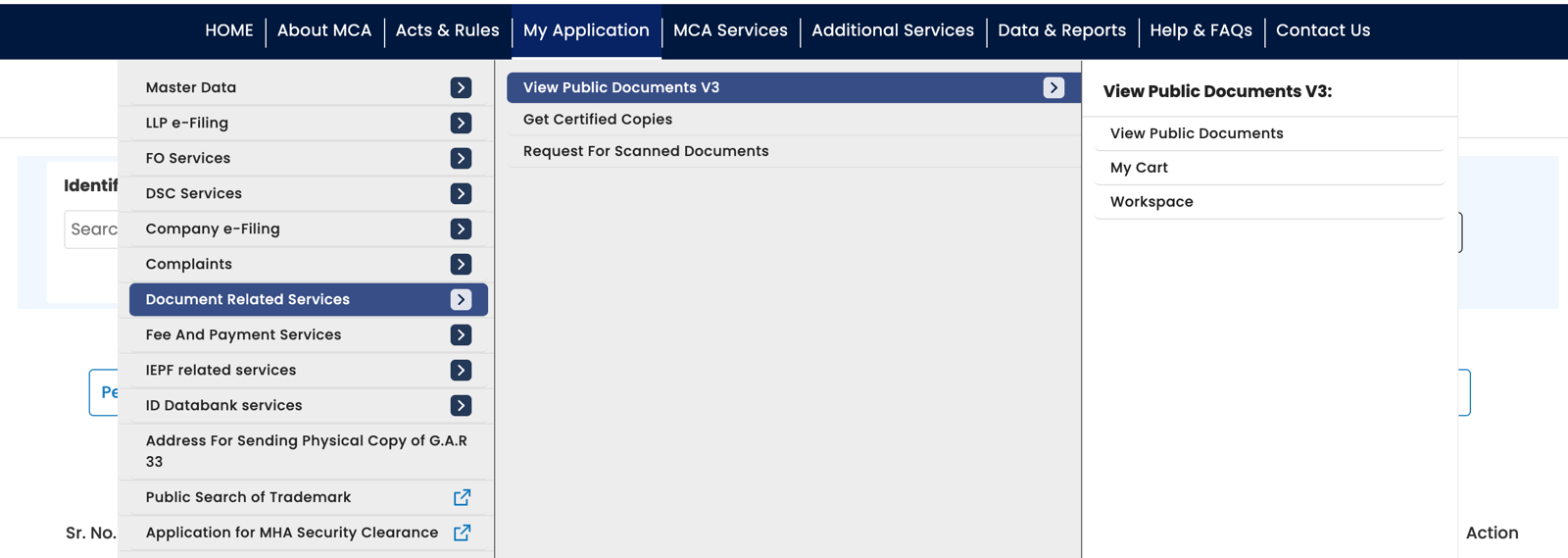
MCA’s menu: Document Related Services, then View Public Documents V3, then View Public Documents. - Find the company and pay ₹100. Search using its CIN, then open it from your Workspace.
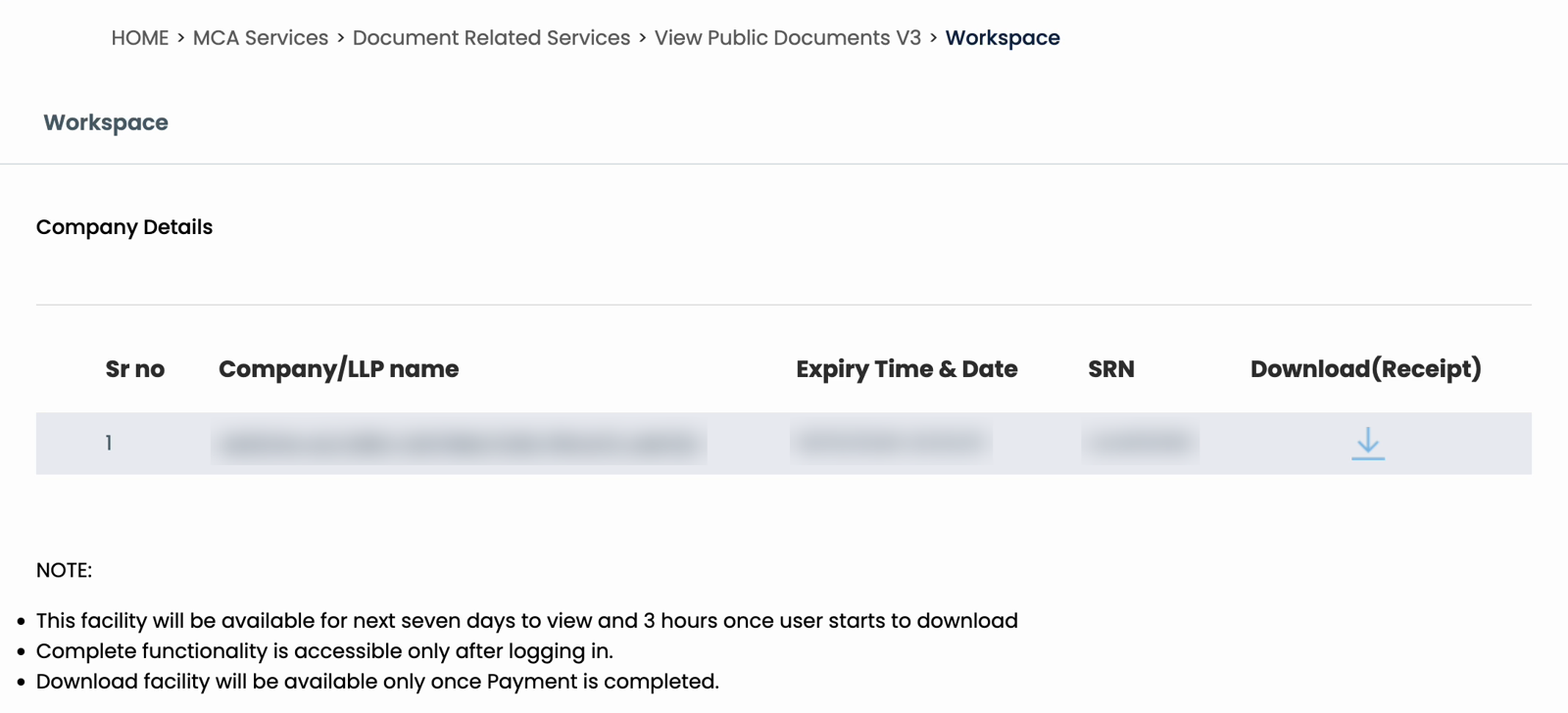
Your Workspace after paying: the company, the expiry time and the SRN. Details blurred. - Select the years and Other eForm Documents. Look for PAS-3 and its supporting documents. Widen the year range if an expected allotment is missing: it may have been filed later.
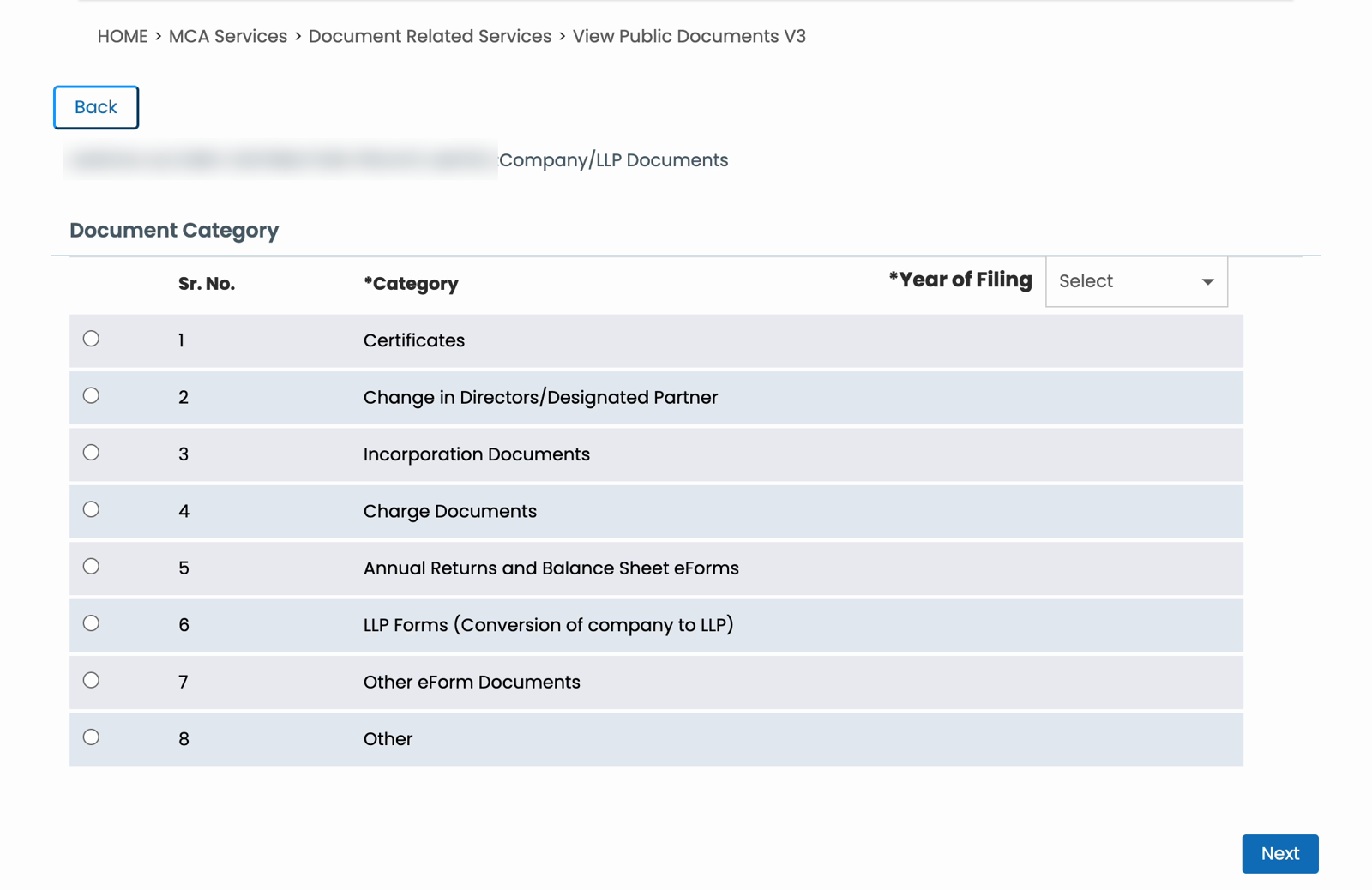
The category page. Other eForm Documents is number 7. Company name blurred. - Download the form and attachments. Include the list of allottees and any relevant resolutions, contracts or valuation reports. Select up to five documents per batch, click Download, enter the captcha and submit.
- Extract the zip and check inside the PDF. Supporting files may be separately listed or embedded in the form. Open the attachments panel using the paperclip icon in desktop Adobe Acrobat Reader.
The allottee list may be a PDF or spreadsheet. It can also be bundled with a resolution under an optional attachment label, so check the contents rather than relying only on filenames.
For older allotments, look for Form 2, the predecessor under the Companies Act, 1956. If an older form displays “Please wait” in your browser, try desktop Acrobat Reader.
Save the files within MCA’s access window. For payment and download problems, see the full MCA download guide.
How much did the investor pay? Face value and premium
Face value is the nominal value of a share. Premium is the amount charged above that value. They are different from the company’s valuation.
Suppose 10,000 shares with a face value of ₹10 are issued at a premium of ₹90 each, fully paid in cash:
- Issue price: ₹10 + ₹90 = ₹100 per share.
- Total subscription amount: 10,000 × ₹100 = ₹10 lakh.
- Increase in paid-up share capital: 10,000 × ₹10 = ₹1 lakh.
- Securities premium: 10,000 × ₹90 = ₹9 lakh.
This explains why a company’s paid-up capital can look small compared with the funding it raised. Premium is accounted for separately.
For partly paid shares, check the amount actually paid and what remains payable. Do not treat the full issue price as money already received. Compare the form’s totals with the allottee list; if they disagree, resolve the difference before relying on the amount.
Does every allotment mean someone invested money?
No. Check how and why the securities were issued:
- Cash subscription: investors pay for the securities. Check the paid amounts.
- Bonus issue: existing shareholders receive additional shares without paying fresh money.
- Conversion: a loan, debenture or preference share converts into another security; the conversion itself may bring no new cash.
- Other non-cash consideration: shares may be issued for assets or a business instead of money.
A debenture allotment records debt securities, not an equity ownership percentage. Read any supporting contract or valuation report available for the transaction.
Does a new issue dilute existing shareholders?
Dilution means an existing holder’s percentage falls as more shares are issued to others.
Suppose you own 100 of a company’s 1,000 identical, fully paid equity shares: 10%. If it issues 250 more to someone else, you still own 100, but out of 1,250: 8%.
PAS-3 supplies the new allotment, but you also need the starting share count and other changes. Preference rights, conversions and employee options can make the calculation more complex. Use the annual return and shareholder records to cross-check the ownership picture.
What is SH-7, and how is it different?
PAS-3 reports allotments. SH-7 reports specified alterations of share capital, such as an increase in authorised capital or a subdivision of shares.
Authorised capital is the company’s permitted nominal share-capital ceiling. Increasing it creates room for more shares; it does not prove that shares were issued or money was raised. An allotment within the existing ceiling need not require a fresh increase.
A share split changes the number and face value of shares without itself bringing in money. For example, one ₹10 share becomes ten ₹1 shares. This matters when comparing share counts and prices across years.
Read SH-7 alongside the capital clause in the company’s MOA.
Download the supporting records with ROCwork
ROCwork downloads selected years and categories from your logged-in MCA tab after you pay MCA’s fee. It checks zips, retries failed downloads and organises the files with an Excel index.
Collect PAS-3, its attachments and relevant annual returns together. Keep a timeline of allotment dates, recipients, security classes, quantities and prices. Check for duplicate copies before adding up totals.
FAQ
How do I find out who invested in a private company?
You can find out who invested in a private company from its PAS-3 filings on MCA, when the company issued new shares. The list of allottees shows who received them, how many and at what price. If the investor bought existing shares instead, there is no PAS-3; look for them in the annual return’s shareholder list.
Does PAS-3 show every shareholder of a company?
PAS-3 does not show every shareholder of a company. It identifies the recipients of the allotments it reports. The allottee list can reveal an investor’s entry, but it does not establish what they own today. Later issues, transfers, conversions or buybacks may change their holding. Check subsequent records and the relevant shareholder list.
Can I calculate a company’s valuation from PAS-3?
You cannot calculate a company’s valuation from PAS-3 alone. It gives an issue price, and price alone is not the valuation. A simple implied equity valuation also needs the relevant total share count. Different share rights, convertible securities and employee options affect that calculation. Do not multiply a preference-share price by an unrelated equity-share count.
What is the due date for filing PAS-3?
The due date for filing PAS-3 is 15 days from allotment for a private placement and 30 days for other allotments, according to MCA’s PAS-3 instruction kit. For research, use the actual allotment date inside the form. A filing date alone does not establish when the securities were issued.
Why can’t I find the list of allottees?
You may not find the list of allottees because it can be a separate download, an embedded PDF or spreadsheet, or part of an optional attachment. Check all three places and match the company, allotment date, security class and quantities. If it is still missing, the form’s totals alone cannot identify every recipient.
Does a missing PAS-3 mean the company raised no funding?
A missing PAS-3 does not prove that no funding occurred. Check a wider filing period, older Form 2 records and supporting financial statements. The company may also have borrowed money without allotting securities. A search result is not a complete record of every source of finance.
Sources: MCA’s PAS-3 instruction kit, SH-7 instruction kit, and V3 forms FAQ, alongside downloaded PAS-3 filings and attachments. ROCwork is a product of Consara Technologies Private Limited and is not affiliated with the Ministry of Corporate Affairs.