To check charges on a company, start with its index of charges on MCA. For the supporting filings, open View Public Documents and select Charge Documents. Look for CHG-1, CHG-4 and their attachments; related certificates can be under Certificates.
These records help you identify assets given as security and the parties holding that security. They are not a complete list of the company’s loans or a statement of how much it owes today.
What is a charge? Start with the loan
When a company takes a loan, it agrees to repay the lender on agreed terms. The lender may also ask for security—for example, a factory or machinery that backs the borrowing.
A charge is the lender’s legal right over those assets as security. It gives the lender rights to recover money from the secured assets if the company defaults, subject to the agreement and applicable law. It is not a fee or an interest charge.
For example, a company borrows ₹1 crore to buy a machine and gives the bank security over it. The machine can remain in use by the company while backing the loan. The charge records that security arrangement.
A loan can also be unsecured, meaning it has no such asset security. That is why checking charges alone cannot reveal every loan.
Creation, modification and satisfaction: what do they mean?
| Term | In simple language |
|---|---|
| Creation of charge | Security is established over specified assets. Its particulars are registered with the Registrar of Companies. |
| Modification of charge | An existing charge changes—for example, the amount secured or the assets covered. It need not be a new loan. |
| Satisfaction of charge | The obligation secured by that charge has been paid or satisfied in full, and this is reported for recording. |
In the machine example, once the secured dues are fully settled, satisfaction of that charge can be reported through CHG-4. Check the recorded status and satisfaction certificate as well as the form.
Repayment and updating MCA’s record are separate steps. A missing satisfaction date is a reason to investigate; it does not, by itself, prove the loan is still unpaid.
Which charge forms should you look for?
| Form or document | What it tells you |
|---|---|
| CHG-1 | Creation or modification of a charge other than one relating to debentures. |
| CHG-9 | Creation or modification of a charge relating to debentures—a form of debt security. |
| CHG-4 | Intimation of payment or satisfaction of a charge in full. |
| Charge certificates | The Registrar’s record of registration, modification or satisfaction. |
CHG-1 includes the charge holder, the maximum amount secured, the instrument date and details of the assets. The charge holder may be a lender or a trustee acting for others, so read the underlying document too.
The supporting attachment may be a mortgage or hypothecation deed, rather than the complete loan agreement. CHG-4 may include a no-dues certificate from the lender.
How to check a company’s index of charges
On mca.gov.in, open Company/LLP Master Data, find the company by its name or CIN, and look for its charge details. Complete login or captcha prompts as required.
The index can show the charge ID, charge holder, amount, creation date, modification date and satisfaction date. Note the charge ID: it helps you match the index entry with the filings and certificates.
Treat a missing satisfaction date as no satisfaction shown in that record. Check the related filings before deciding what it means.
How to download CHG-1 and CHG-4 from MCA
You need an MCA login, the company’s CIN and ₹100 for access to its public documents. If you do not have a login, start with how to make an MCA ID.
- Log in to mca.gov.in. Open MCA Services → Document Related Services → View Public Documents V3 → View Public Documents.
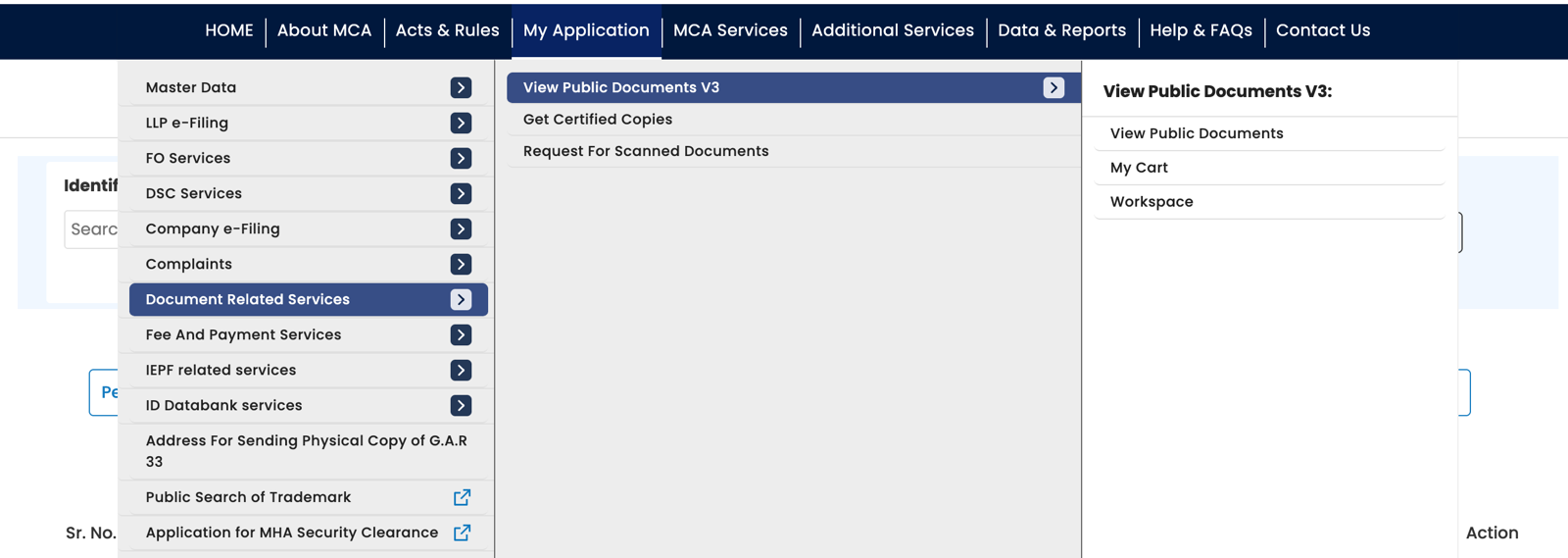
MCA’s menu: Document Related Services, then View Public Documents V3, then View Public Documents. - Find the company and pay ₹100. Search by CIN, add the company and complete payment. Open it from your Workspace.
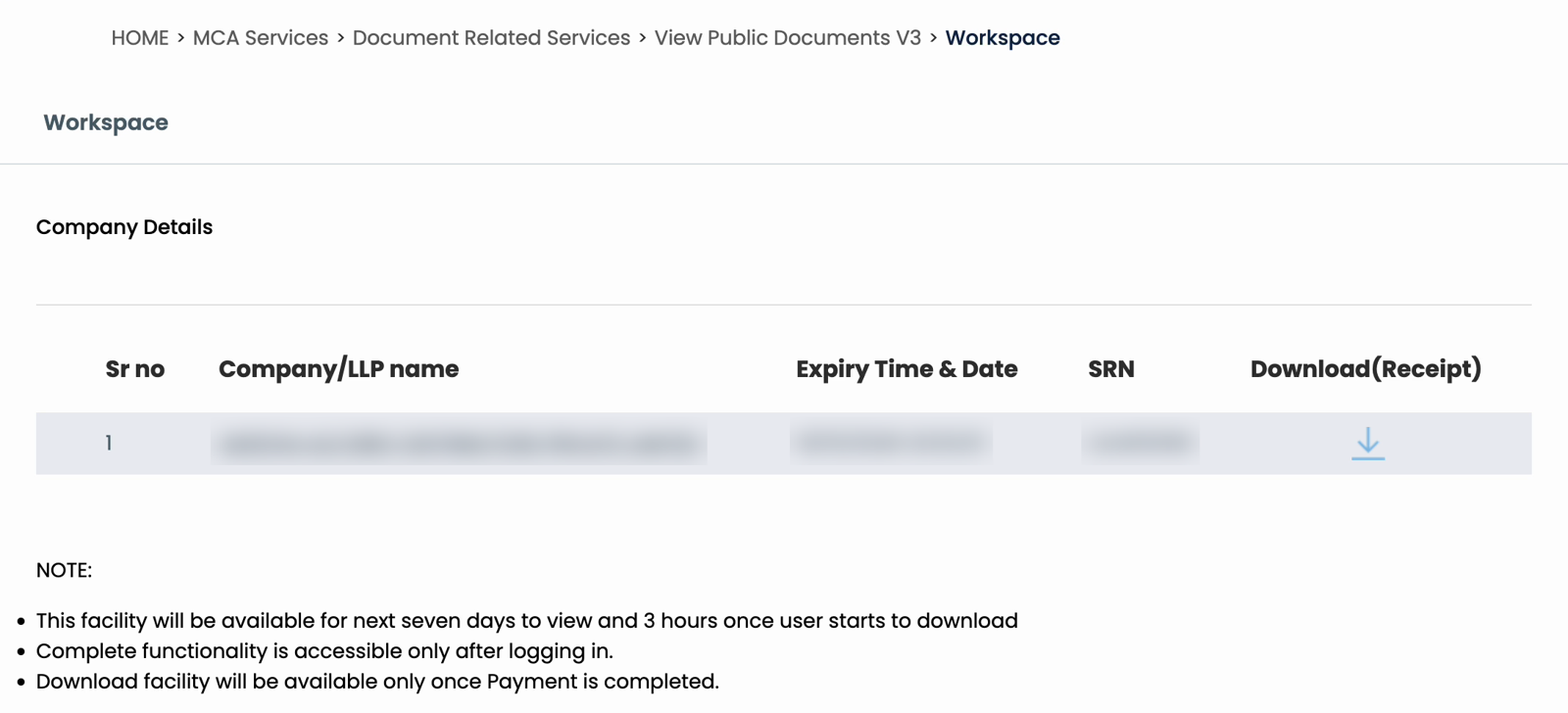
Your Workspace after paying: the company, the expiry time and the SRN. Details blurred. - Choose the years and category. Select Charge Documents. Search all available years if you need the charge’s history.
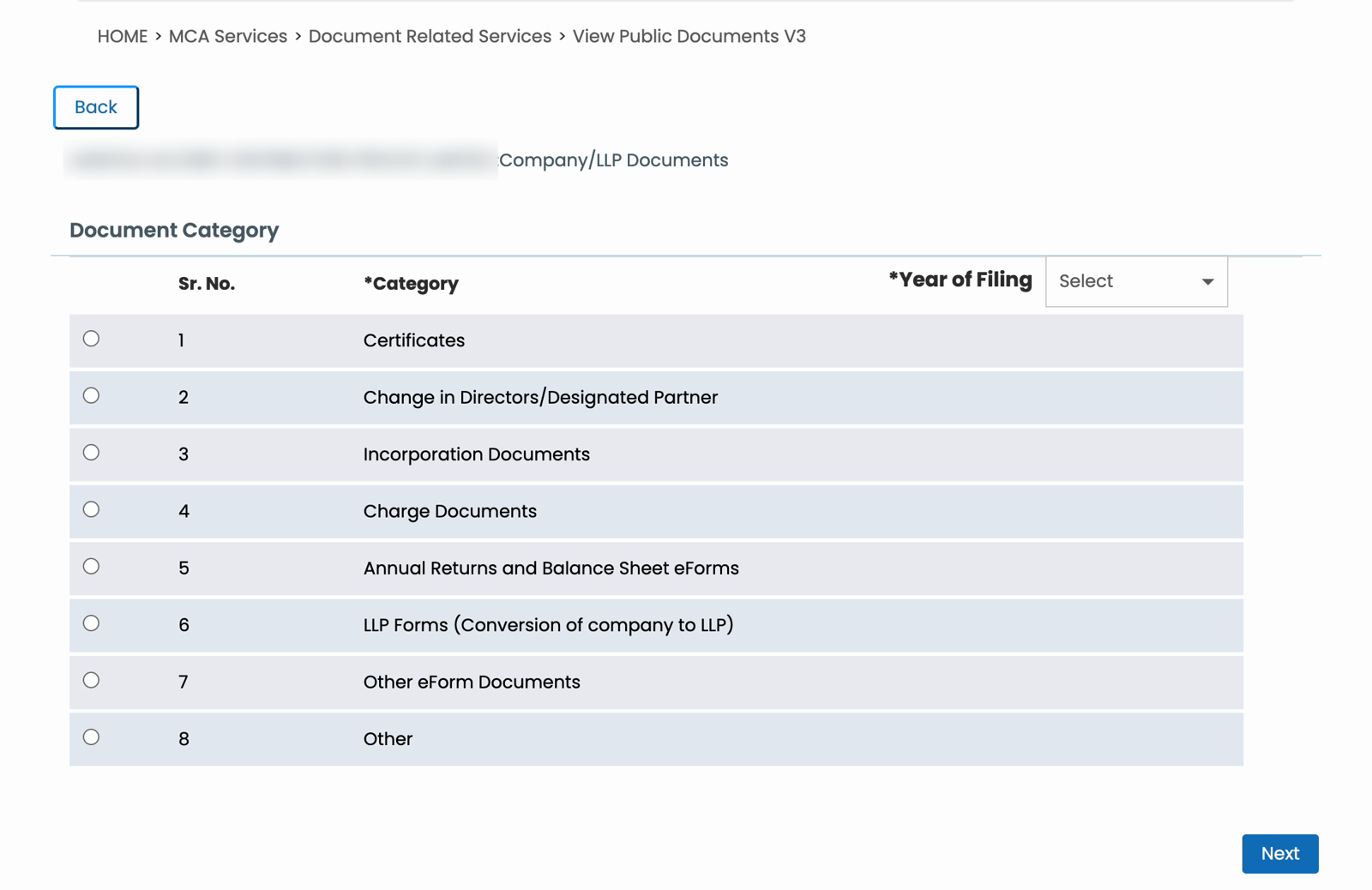
The category page. Charge Documents is number 4 and Certificates number 1. Company name blurred. - Select the forms and attachments. Choose up to five documents, click Download, enter the captcha and submit. Extract the files from the zip.
- Check Certificates too. Download the relevant registration, modification or satisfaction certificates and match their charge IDs.
Also check inside the form PDF. Supporting documents may be in the attachments panel, accessible through the paperclip icon in desktop Adobe Acrobat Reader.
The dates can differ. One CHG-4 listed on MCA under 22 June 2026 reported satisfaction on 4 June; its certificate was issued on 3 July.
Downloads can take time, and access is time-limited. Save the documents you need within the access window shown on MCA. For payment and download problems, see the full MCA download guide.
What should you check before drawing conclusions?
- The amount: “maximum amount secured” is not today’s loan balance. Do not add up charge amounts and call the result total debt.
- The history: a creation and later modifications may belong to the same charge. Match the charge IDs to avoid counting them as separate borrowings.
- The assets: read the actual security description. A charge on one property does not prove that every other asset is free of charges.
- The status: an open charge does not prove default. A satisfied charge does not mean all the company’s other loans have been repaid.
For reported borrowings at a financial year end, read the company’s financial statements and notes. If the documents disagree, seek the lender’s confirmation and current loan statements.
Download the charge documents with ROCwork
ROCwork downloads the selected years and categories from your logged-in MCA tab after you pay MCA’s fee. Select Charge Documents and Certificates to collect the supporting records together.
ROCwork checks the zips, retries failed downloads and sorts the files into folders with an Excel index. You still need to read the records to establish what each charge covers.
FAQ
Does an open charge mean the company has defaulted?
An open charge does not mean the company has defaulted. It means MCA’s record does not show the charge as satisfied. The borrowing may still be running normally, or satisfaction may not yet be recorded. Check the lender’s confirmation and loan records before concluding that the company has defaulted.
Does charge satisfaction mean the company is debt-free?
Charge satisfaction does not mean the company is debt-free. It relates to one particular charge, not every borrowing. The company may still have other secured loans, unsecured loans or new financing. Match the satisfaction document to its charge ID and check the other borrowing records before drawing a wider conclusion.
Is the charge amount the outstanding loan amount?
The charge amount is not necessarily the outstanding loan amount. CHG-1 asks for the maximum amount secured, which may differ from the amount drawn or still unpaid. Use the financial statements for the reported year-end balance and lender records for a more recent position.
Can I download the loan agreement from MCA?
You can download the document that created the charge from MCA, but not necessarily the full loan agreement. A charge filing may include the instrument creating or modifying the security, such as a hypothecation or mortgage deed. Check the separate attachment rows and the form PDF’s embedded attachments to see what was filed.
Does having no charges mean a company has no loans?
No charges on MCA does not mean a company has no loans. It may still have unsecured borrowings, and missing or incomplete filings can limit what you find. Use the charge search alongside the company’s financial statements and loan records before concluding that it has no debt.
Sources: MCA charge filings and certificates; the Companies Act on India Code; and MCA’s CHG-4 instruction kit. ROCwork is a product of Consara Technologies Private Limited and is not affiliated with the Ministry of Corporate Affairs.